Rust Sulfur Heist Raiding Guide
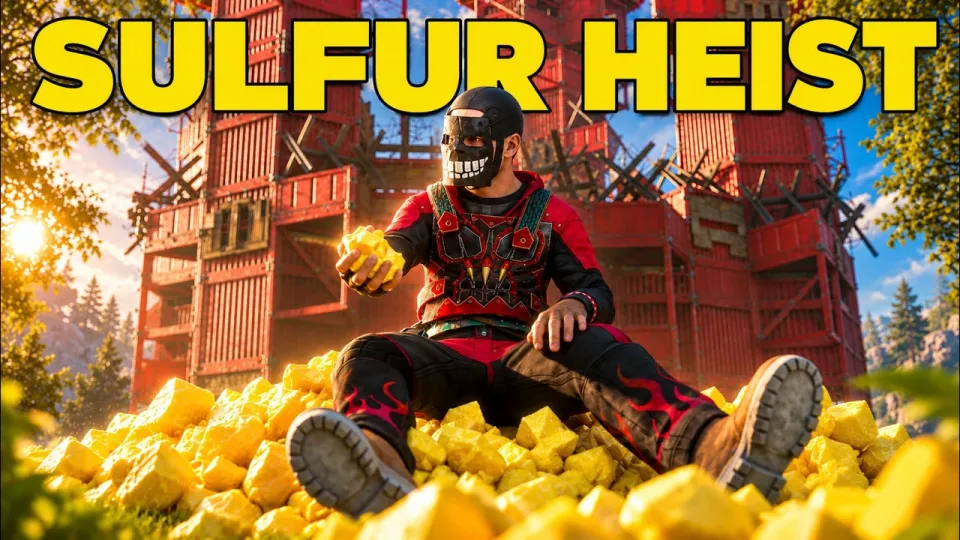
Video: We Stole Their ENTIRE SULFUR STASH - Rust
Want articles like this for your own video to promote it on YouTube and Google? Order them through the Telegram bot @sat_sit_bot. The bot writes and publishes the articles itself (with your YouTube video embedded) on popular topical websites (no ads). Try it free: 50 articles on us.
Key takeaways
- Sulfur is the core raid currency in Rust: gunpowder, explosives and rockets all trace back to it.
- A full sulfur stash can be worth dozens of rockets, so one clean breach can fund an entire wipe.
- Heists work best in small squads with split roles: scout, breacher, hauler and overwatch.
- The Schoolwe video shows a squad pulling off a raid-focused run and stealing a rival group's sulfur supply.
- Defense is cheaper than offense: spread loot across bases and keep sulfur in a separate, low-profile room.
A Rust sulfur heist is a raid built around one goal: taking another group's sulfur supply instead of grinding it yourself. Sulfur is the raw material behind gunpowder, explosives and rockets, so a single successful breach can hand a squad enough resources to fund an entire wipe. The Schoolwe video We Stole Their ENTIRE SULFUR STASH follows exactly that plan, and the HyperTune site linked in the video is where the channel sends viewers for its sponsor offer.
Why sulfur drives every Rust raid
Sulfur is the bottleneck resource in Rust because every explosive item is built from it. Gunpowder takes one sulfur and two charcoal; explosives and rockets then consume that gunpowder in bulk, which means a rocket raid is really a sulfur raid. A group that controls more sulfur controls the pace of the wipe: it decides who gets raided and who has to farm.
That is why a sulfur stash is a more valuable target than a box of guns. Guns are replaceable through crafting and trades, but sulfur represents hours of mining nodes, smelting and travel. Stealing it does double damage — the raiders gain raid capability and the victims lose the ability to retaliate.
- 1 sulfur + 2 charcoal = gunpowder, the base of all explosives.
- Rockets and C4 are the main consumers of gunpowder in a raid.
- Sulfur comes from mining nodes and from recycling, so it is renewable but slow.
- A stash sitting in one obvious room is the easiest thing on the map to lose.
How a sulfur heist is planned
A sulfur heist starts with scouting, not with explosives. Before spending a single rocket, the attacking group needs to know where the target keeps its sulfur, how many players are online, and how quickly they can respond. The Schoolwe run is built on that logic: the squad moves with a raid plan instead of farming first and raiding later.
A practical sequence looks like this:
- Identify a target group by activity — who is farming sulfur nodes, who is running monuments, who built recently.
- Watch the base for a session or two to learn door paths, turret coverage and offline hours.
- Estimate the cost of the breach in sulfur and compare it with the expected loot.
- Stage rockets, explosives and a fallback stash near the target, not at your own base.
- Assign roles before the first explosion: breacher, hauler, overwatch and a driver for the escape.
The comment section under the video keeps returning to the same idea — viewers noticed the squad spent more time raiding than fighting players. That is a real lesson: a heist is a logistics operation, and the group that treats it like a PvP brawl usually loses the loot on the way out.
Breaching a base without wasting rockets
Breaching is where most sulfur gets wasted. Every rocket fired at the wrong wall is sulfur that never comes back, so the breach should follow the cheapest path to the loot room rather than the most dramatic one. Soft-side walls, sheet metal doors and unupgraded ceilings are all cheaper entries than a hardened core.
Key habits for a clean breach:
- Check wall materials before firing; a stone wall and an armored wall are different budgets.
- Use splash damage on door frames and corners to open multiple paths with fewer explosives.
- Keep one player on overwatch with a long-range weapon while others breach.
- Bring more explosives than the plan requires — counters and repairs happen mid-raid.
- Clear the base room by room instead of rushing the core; defenders love a corridor ambush.
The Schoolwe video pushes toward rockets early, and that is the standard escalation once a group already has sulfur to spend. The important part is that the raid is funded by stolen resources, which turns the heist into a self-sustaining loop.
Hauling loot and keeping the sulfur
Hauling is the step most raiders underestimate. A sulfur stash is heavy and split across boxes, and the trip back to base is when counter-raids happen. The attackers in the video end up with the loot, but the general rule holds: the raid is not finished until the sulfur is inside your own walls.
Useful practices for the haul:
- Bring a vehicle or a boat if the route allows it, and park it behind cover.
- Split the loot between players so one death does not cost the whole stash.
- Move sulfur first, guns second, junk last — prioritize what funds the next raid.
- Do not sort boxes inside the raided base; leave and sort at home.
- Expect the victims to return with friends, and leave a scout watching the route.
Defending your own sulfur stash
Defending sulfur is cheaper than raiding for it. The simplest defense is separation: keep sulfur in a small, low-profile room that is not next to the main loot, and never store the whole supply in one box. A group that loses its entire sulfur stash in one breach loses the wipe, which is exactly the scenario the video's title describes.
Practical defensive measures:
- Spread sulfur across two or three bases, including a hidden backup.
- Put the sulfur room behind extra doors and away from the main entrance path.
- Use turrets and traps on the approach, not only inside the core.
- Keep the base looking poorer than it is; visible rockets attract raids.
- Log out with high-value sulfur in your inventory when the server is hot.
Questions viewers keep asking about the run
Viewers of the Schoolwe video raised several recurring points that are worth answering directly. One is length: a number of comments ask for longer episodes, since a single raid-focused video leaves out the farming and scouting phases that make a heist work. Another is the crew — viewers want to see the original group reunited for future runs.
The most practical request is a base guide. The design used in the video drew praise, and viewers asked for a breakdown of the layout, which makes sense: a compact base with a clear loot path is what makes both raiding and defending easier. Others asked which server the run took place on, a common question for any Rust video, since server rules and population change how aggressive a squad can be.
There is also the wall-in idea — one comment suggested boxing in a monument such as Launch Site. That is a known tactic on some servers but depends heavily on rules and population, so treat it as a creative option rather than a default strategy.
Useful links
- Sponsor offer from the video: https://hptn.gg/schoolwe
- Community Discord: https://discord.gg/schoolwe
- Twitter: https://twitter.com/Schoolwe_
- Twitch: https://www.twitch.tv/schoolwe_
Final takeaway
A sulfur heist in Rust is a planning problem disguised as a raid: scout the target, breach the cheapest path, haul the sulfur first and defend your own stash with separation and redundancy. The Schoolwe video shows the payoff side of that equation, with a squad turning stolen sulfur into rockets and a full raid run. Use the HyperTune link from the video if you want to support the channel's sponsor, and treat the run as a template rather than a script — the map, the server and the neighbors decide how it actually plays out.
Source: We Stole Their ENTIRE SULFUR STASH - Rust · Markdown version
Questions & answers
What is a sulfur stash in Rust and why is it worth raiding?
A sulfur stash is a group's stored sulfur, the raw material for gunpowder, explosives and rockets. Raiding it is efficient because the attackers gain raid capability while the victims lose the ability to craft explosives and retaliate.
How much sulfur should a squad bring for a raid?
It depends on the target's wall materials, but the safe approach is to calculate the cheapest breach path and then bring extra for counters and repairs. Underestimating the cost mid-raid is the most common way a heist fails.
Why do Rust videos like this one feel short to viewers?
Raid-focused videos cut out farming, scouting and travel, which are a large part of a real wipe. Comments on the Schoolwe video ask for longer episodes because those phases explain how a heist is actually set up.
How do you protect your own sulfur from being stolen?
Split sulfur across multiple bases, keep it in a small room away from the main loot path, and add turrets or traps on the approach. A single obvious sulfur room is the easiest target on the map.